Morris County Dog Registration Information
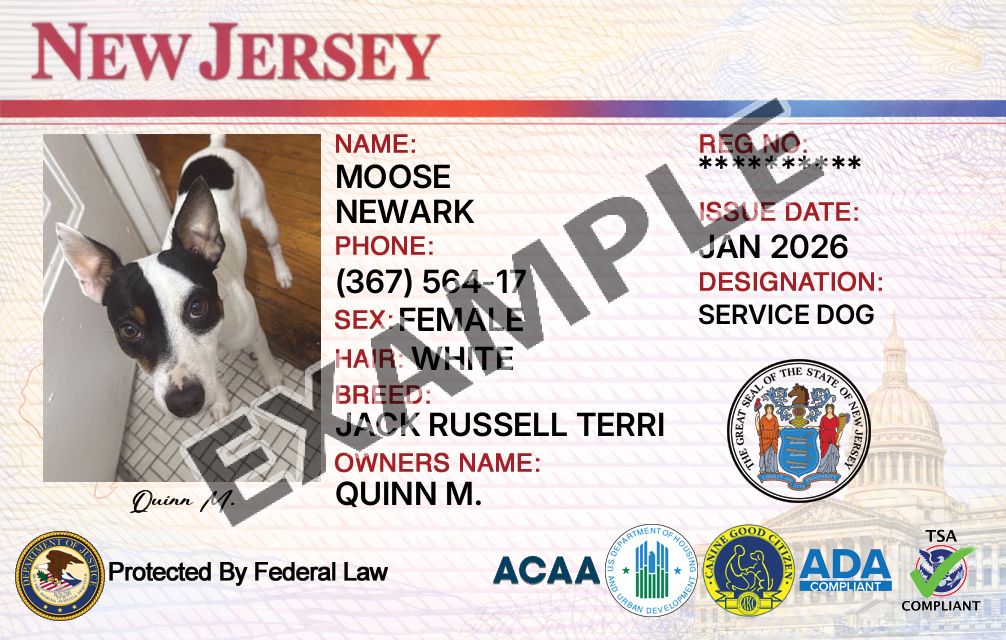
Service Dogs and Emotional Support Animals in Morris, New Jersey
If you’re asking where do I register my dog in Morris County, New Jersey for my service dog or emotional support dog, the most important thing to know is this: in New Jersey, the “registration” most people mean is a municipal dog license, and that license is typically handled by the town (municipality) where you live—not by a private company and not usually by the county.
This landing page explains how a dog license in Morris County, New Jersey works, what rabies paperwork you’ll need, and how licensing differs from your dog’s status as a service dog (trained for disability-related tasks) or an emotional support animal (ESA). You’ll also find a list of example official offices to contact if you’re trying to figure out where to register a dog in Morris County, New Jersey.
Where to Register or License Your Dog in Morris County, New Jersey
Because licensing is handled locally, you generally register (license) your dog through your municipal clerk’s office, health department, or the local office that administers animal licensing. Below are several official examples within Morris County, New Jersey to help you identify the right type of office to contact in your town. If your municipality is not listed, use this as a model: look for your town’s “Pet Licensing,” “Animal Licensing,” “Health Department,” or “Township Clerk” page.
Example Office: Town of Morristown
Division of Health (Animal Control Services / Pet Licensing)
- Address: 200 South Street, P.O. Box 914
- City/State/ZIP: Morristown, NJ 07963-0914
- Phone: (973) 796-1975
- Hours: Monday to Friday, 8:30 a.m. to 4:30 p.m.
Example Office: Hanover Township (Whippany)
Administration & Township Clerk (Pet Licensing)
- Address: 1000 Route 10
- City/State/ZIP: Whippany, NJ 07981
- Phone: 973-428-2500
- Hours: Mon–Thu 8:00 a.m. to 4:30 p.m.; Fri 8:00 a.m. to 1:00 p.m.
- Email: Not listed on the pet licensing information page (use the township’s “Email” contact option for the Clerk when available).
Example Office: Township of Parsippany-Troy Hills
Municipal Dog Licensing (Municipal Clerk’s Office contact)
- Mailing/Office Address (as shown on the dog license application): 1001 Parsippany Blvd.
- City/State/ZIP: Parsippany, NJ 07054
- Phone: 973-263-4351
- Email: Not listed on the dog license application.
- Hours: Not listed on the dog license application.
County Resource (Rabies Clinics)
Morris County Rabies Clinics (schedule resource)
- What it is: A county page listing rabies clinic opportunities hosted by Morris County municipalities.
- Address/Phone/Hours: Not a single office listing (the page provides municipality-by-municipality clinic details).
- Notes: The county states rabies vaccines at listed clinics are free and open to all New Jersey residents, and typically require no paperwork to attend.
Overview of Dog Licensing in Morris County, New Jersey
What “registration” usually means in New Jersey
In everyday conversation, people often say they want to “register” their dog. In New Jersey, that typically means obtaining a municipal dog license—a license issued by your city, township, or borough. A municipal license is used for public health and animal control purposes (including rabies enforcement), and it helps local animal control return lost dogs to their owners.
Licensing is local (and the rules can differ by municipality)
Morris County includes many municipalities, and while state law sets baseline requirements, towns commonly set their own deadlines, processes (in-person, mail, online portal), and fees. That is why the best answer to where to register a dog in Morris County, New Jersey is usually: your local municipal office.
Rabies vaccination is a core requirement
New Jersey requires evidence of rabies vaccination (or a documented exemption where applicable) before a municipal licensing official can issue a dog license and tag. New Jersey also recognizes “duration of immunity” rules for rabies vaccination, and licensing generally depends on your dog’s rabies coverage remaining valid through a required portion of the licensing period.
How Dog Licensing Works Locally in Morris County, New Jersey
Step-by-step: how to get a municipal dog license
- Find your issuing office. Most towns route pet licensing through the municipal clerk or the health department (sometimes listed under animal control).
- Confirm your dog is of licensing age. New Jersey guidance commonly references licensing for dogs 7 months of age or older. If you adopted a dog or moved into town, many municipalities also require you to license within a specified timeframe.
- Bring rabies documentation. The licensing official will typically require proof that the dog has been inoculated with an approved rabies vaccine (or a valid exemption). New Jersey guidance also uses “duration of immunity” rules to determine whether the rabies expiration date qualifies for the license period.
- Provide supporting details and pay the fee. You may be asked for owner identification and local residency information (varies by municipality). Fees often differ depending on whether the dog is spayed/neutered and whether it’s a service dog (some municipalities list a service dog license fee of $0).
- Receive the license and tag. Municipalities typically issue a license certificate/receipt and an official tag to attach to the dog’s collar.
Rabies clinics and renewal timing
Morris County publishes a rabies clinic schedule page and notes that county towns hold rabies clinics each year, and that rabies vaccines listed there are free and open to New Jersey residents. Many pet owners time vaccination and license renewal together so they can submit current rabies proof to the licensing office.
Avoid common pitfalls
- Using third-party “registration” sites: a municipal dog license is issued by a government office, not by a vendor.
- Assuming your ESA letter replaces licensing: an ESA-related document does not substitute for a municipal dog license.
- Rabies expiration date issues: some towns apply state guidance that rabies immunity must extend through a required portion of the licensing period; if your certificate expires too soon, you may need a booster before the license can be issued.
Service Dog Laws in Morris County, New Jersey
Service dog status is not created by a “registration”
A service dog is generally understood as a dog that is individually trained to do work or perform tasks for a person with a disability. Your dog’s service dog status is based on training and the handler’s disability-related needs—not on purchasing an ID card, certificate, or online registration.
A service dog can still need a municipal dog license
Even if your dog is a service dog, you generally still need to comply with local public health rules, including rabies vaccination and local licensing. Some municipalities list a $0 fee for service dog licensing while still issuing the local license and tag. The key point: the dog license in Morris County, New Jersey is about municipal compliance, while service dog rights relate to disability access laws.
What local offices may ask (and what they shouldn’t)
For licensing purposes, your town may ask for standard licensing documentation (rabies certificate, spay/neuter proof if relevant, owner contact details, fee). For service dog access in public places, businesses are generally limited in what they can ask. If you’re unsure, focus on licensing through your town office for the dog license, and address service dog access questions separately (especially for housing vs. public access issues).
Emotional Support Animal Rules in Morris County, New Jersey
An emotional support animal (ESA) is not the same as a service dog
An emotional support animal provides comfort or emotional support, but ESAs are not the same as trained service dogs that perform specific tasks. Because of that distinction, ESA-related paperwork does not automatically grant the same public-access rights as a service dog.
Licensing: ESAs typically follow the same local rules as any pet dog
If you have an ESA dog, you still generally need the same local license as any other resident dog. In other words, the answer to where do I register my dog in Morris County, New Jersey for my service dog or emotional support dog is usually the same: you obtain the municipal license through your local clerk/health department office, and you meet rabies vaccination requirements. ESA status is usually most relevant in housing contexts, not for the municipal licensing process.
Rabies and public health requirements still apply
Whether your dog is a pet, an ESA, or a service dog, public health rules—especially rabies vaccination and local animal licensing—are typically enforced the same way. If your dog lives in your Morris County municipality, expect to show current rabies vaccination proof (or a valid exemption if permitted) to obtain or renew the municipal dog license.
Frequently Asked Questions
Register A Dog In Other New Jersey Counties
Select your county below to get started with your dog’s ID card. Requirements and license designs may vary by county, so choose your location to see the correct options and complete your pup’s registration.
- Atlantic County Dog Registration
- Bergen County Dog Registration
- Burlington County Dog Registration
- Camden County Dog Registration
- Cape May County Dog Registration
- Cumberland County Dog Registration
- Essex County Dog Registration
- Gloucester County Dog Registration
- Hudson County Dog Registration
- Hunterdon County Dog Registration
- Mercer County Dog Registration
- Middlesex County Dog Registration
- Monmouth County Dog Registration
- Ocean County Dog Registration
- Passaic County Dog Registration
- Salem County Dog Registration
- Somerset County Dog Registration
- Sussex County Dog Registration
- Union County Dog Registration
- Warren County Dog Registration